We Are Four

1 01 2011

A few days ago I planned to walk our dog, Zeke, to the dog park.  The snow from a week ago is still on the ground, and my walk would take me through the woods behind our house.  I thought it might be a good time to read some poetry on my walk.  I picked up a small volume from the bookshelf, “Wordsworth’s Shorter Poems.”  It turned out to be more than I bargained for.

I forwent the introduction to his life, philosophy, and poetry and dove headlong into the first poem.  I finished “The Reverie of Poor Susan” and turned the page to find “We are Seven.”  I will reproduce the entirety here.  I hope it needs no explanation.

——–A SIMPLE Child,
          That lightly draws its breath,
          And feels its life in every limb,
          What should it know of death?

          I met a little cottage Girl:
          She was eight years old, she said;
          Her hair was thick with many a curl
          That clustered round her head.

          She had a rustic, woodland air,
          And she was wildly clad:                                    10
          Her eyes were fair, and very fair;
          –Her beauty made me glad.

          “Sisters and brothers, little Maid,
          How many may you be?”
          “How many? Seven in all,” she said
          And wondering looked at me.

          “And where are they? I pray you tell.”
          She answered, “Seven are we;
          And two of us at Conway dwell,
          And two are gone to sea.                                    20

          “Two of us in the church-yard lie,
          My sister and my brother;
          And, in the church-yard cottage, I
          Dwell near them with my mother.”

          “You say that two at Conway dwell,
          And two are gone to sea,
          Yet ye are seven!–I pray you tell,
          Sweet Maid, how this may be.”

          Then did the little Maid reply,
          “Seven boys and girls are we;                               30
          Two of us in the church-yard lie,
          Beneath the church-yard tree.”

          “You run about, my little Maid,
          Your limbs they are alive;
          If two are in the church-yard laid,
          Then ye are only five.”

          “Their graves are green, they may be seen,”
          The little Maid replied,
          “Twelve steps or more from my mother’s door,
          And they are side by side.                                  40

          “My stockings there I often knit,
          My kerchief there I hem;
          And there upon the ground I sit,
          And sing a song to them.

          “And often after sunset, Sir,
          When it is light and fair,
          I take my little porringer,
          And eat my supper there.

          “The first that died was sister Jane;
          In bed she moaning lay,                                     50
          Till God released her of her pain;
          And then she went away.

          “So in the church-yard she was laid;
          And, when the grass was dry,
          Together round her grave we played,
          My brother John and I.

          “And when the ground was white with snow,
          And I could run and slide,
          My brother John was forced to go,
          And he lies by her side.”                                   60

          “How many are you, then,” said I,
          “If they two are in heaven?”
          Quick was the little Maid’s reply,
          “O Master! we are seven.”

          “But they are dead; those two are dead!
          Their spirits are in heaven!”
          ‘Twas throwing words away; for still
          The little Maid would have her will,
          And said, “Nay, we are seven!”


Sickness and Healing; Death and Resurrection

2 09 2010

I was recently at a luncheon with my colleagues at Southeastern seminary.  We were talking about music and family and the question arose whether Samuel had any siblings.  I have come to the point where I answer that question differently depending on the circumstances.   Sometimes you meet someone at the park, and you are exchanging niceties.  They notice your son running around with the dog and casually ask if you have other children.  They very well could have asked, “Do you like the weather?”  Their motive is a desire to keep the conversation going.  “No,” you reply.  “We’re just here with Sam.”  At other times, you are in a conversation about your family.  The other person really wants to know about your wife and children and what makes your family interesting.  My conversation at lunch that day was such a conversation.  So I shared Anna’s story.

Not much longer in the conversation we were talking about Sam and his singing.  I mentioned that I had put Sam into a difficult situation one time (many times, actually!) when I asked him to sing at my mother’s funeral last year.  “Oh my,” my friend responded.  “You have had a rough two years.”

Our conversation continued on with other things.  I didn’t tell her about my father and his open heart surgery following my mother’s death.  I didn’t share about the difficulty and stress of changing jobs.  Of moving twice.  Of buying our first home.  Of living out of suitcases, oddly enough even after we moved into our home, for a year and a half.

But her very candid response about what a hard two years I have had gave me pause to reflect for a moment.  It caused me to think again about the very different circumstances surrounding the sudden and accidental death of Anna, the death of my mother after a brief illness and a debilitating surgery, and the healing of my father after his heart was almost completely deprived of blood.

And now another colleague of mine at Southeastern seminary is going through these same times with his wife.  Dave Black and his wife, Becky, are enduring painful times while she is being treated for a very aggressive cancer.  She is recording her story and it is well worth reading.  I will provide a link to their website at the side of this blog.  I know they would appreciate your prayers.

With all of these things going on, I have been reminded, as I often am, of my prayer for my mother while she was in the hospital.  It was Easter Sunday.  She had been through a very invasive surgery to find out the extent of hercancer and to try to remove it.  The effects of the surgery, let alone the cancer, were devastating.  She was very sick.  Several family members stood at her bedside that morning.  I prayed for my mother that morning, but I got stuck in the middle of my prayer.  I realized that I wasn’t quite sure what it was that I was praying for.  For a year I had been thinking about Anna’s death and processing the truth of what the apostle Paul had written two thousand years ago, “To live is Christ and to die is gain.”  I had been meditating on the fact that “to be absent from the body is to be present with the Lord.”  I had been thinking about Jesus’ words to the thief next to him on a cross, “This day you will be with me in Paradise.”  I had concluded that, for Anna, being with the Lord was better for her than to be with me.

Given all of this, what was I to pray for my mother?  Did I want God to “heal” her?  To bring her back home with her broken body?  Knowing that it would not be long before we would be bringing her back to the hospital, for this or some other ailment, until finally, at some point, she would not return home with us?  I don’t recall my words now.  I know that I asked for God to heal her.  I was painfully aware of the fact that not only was my mother listening to what I was praying, but the rest of my family was there listening as well.  I do know that when I finished praying, whatever I had said, I felt the need to apologize to my mother.  I was embarrassed.

After praying with her, I was asked if I would come talk to the nurses on the floor, who were all working on Easter and wanted to have some sort of worship service together.  That might not have been the safest thing to do, for me or for them.  But it provided me another occasion to work through these things.  As I said, I do not recall what I said when I prayed for my mother that morning.  I recall perfectly what I said to the nursing staff that Easter.

“100 percent of your patients will die.  You will lose every patient that comes to your floor.  Oh, they might leave and go home, but they will be back again.  And one day they will not leave the hospital alive.  You will lose every one of them.”  I went on to tell them that if their goal is to keep people alive, they will be bitterly disappointed.  On the other hand, if they understand death as a necessary result of sin, that it is a fact for every person, but if they also understand God’s work of resurrecting the dead, and if they see that future resurrection as an ultimate act of healing and restoration of the body, then they can view their job not as the futile attempt to keep people alive forever, but as a partnering with God in giving people a brief foretaste of what the resurrection will be like.

Every patient at the hospital, whatever their condition now, whether they walk out today or tomorrow, or whether they are confined to continue living in the hospital itself, will one day not leave the hospital alive.  Or, as in Anna’s case, will not even reach the hospital alive.  That is, they will not leave the physical doors of the hospital.  But they will leave the hospital another way.  And God, for those who are saved, is going to work a mighty raising of the dead on the day of his returning.  Every nurse and doctor should be looking ahead to that day with wonder and amazement as the Great Physician comes to work his final miracle of healing by raising from dust and ashes those who have died.

So do we pray for healing now?  Yes, of course.  But why?  So that the sick can live another day, or week, or year or two?  No.  We pray for the sick, so that as God heals them, the world can have a brief glimpse into the resurrection that is to come.  We pray for healing so that the glory of God might be revealed.


Anna, by any other name, would still be Grace

20 08 2010

Anna’s name was taken from the New Testament character in the Gospel of Luke who met the baby Jesus and his parents at his presentation at the temple:

There was also a prophetess, Anna, the daughter of Phanuel, of the tribe of Asher.  She was very old; she had lived with her husband seven years after her marriage, and then was a widow until she was eighty-four.  She never left the temple but worshiped night and day, fasting and praying.  Coming up to them at that very moment, she gave thanks to God and spoke about the child to all who were looking forward to the redemption of Jerusalem.

But the name Anna is really the Greek form of the Hebrew name, Hannah.  When Hebrew words and names were transliterated into Greek (not translated, but simply written with Greek letters) some of the sounds were lost.  The initial “H” in “hannah” was left off of the Greek word and replaced with what we call a rough breathing mark–a replacement for the letter “h”, which does not exist in Greek.  When the name was then transliterated into Latin, the transformation was complete, since Latin not only has no H but has no equivalent of the rough breathing mark of Greek.  The same change occurs with the word Hallelujah.  With the H as the first letter, the word is taken from the Hebrew Old Testament.  Written “Alleluia” without the H, the word represents the Greek and Latin equivalents of the original.

In the Old Testament, Hannah is the mother of Samuel (ironically enough).  Her prayer in the tabernacle when she offered her son, Samuel, to the Lord is recorded in 1 Samuel 2.  Here is one bit taken from her prayer:

There is no one holy like the Lord;

there is no one besides you;

there is no Rock like our God.

The name Hannah, as many Old Testament names, is derived from another word.  Hen is the Hebrew word translated “grace.”  The Greek word used in the New Testament for it is charis.  So, from Hebrew to Greek to English, Anna’s name comes from the Hebrew word for “grace.”

There is another variant of that word that plays a significant role in God’s revelation of his own character.  When God revealed himself to Moses at Mt. Sinai in Exodus 34:6-7, he used these words:

“The Lord, the Lord, the compassionate and gracious God, slow to anger and abounding in steadfast love and faithfulness, maintaining love to thousands, and forgiving wickedness, rebellion and sin.  Yet he does not leave the guilty unpunished; he punishes the children and their children for the sin of the fathers to the third and fourth generation.”

The beginning of the verse in Hebrew begins like this: yahweh, yahweh, el rahun wehanun. That final word, hanun, is the word “gracious.”  This passage became one of the most often quoted passages in the Old Testament to describe God’s character.

It is good to have a name of noble character.  Usually we understand that to mean, and rightly so, that we ought to preserve a good reputation.  But I think, just as important, is to provide our children with names of nobility, good character, examples of heroes of the faith.  When naming children, heritage might be better than originality.


Loving Jesus

19 08 2010

This morning I read something from Charles de Foucauld in Meditations of a Hermit.  “The hour in our life in which we are best empoyed is the hour in which we best love Jesus.  A soul does good to others not in the measure of its knowledge or intelligence but in that of its holiness.”

I was reminded of Timberley’s story about tucking Anna into bed one night.  Anna was not reading as she normally was, but simply staring at the ceiling.  Timberley asked her if everything was okay.  Anna answered, “Oh, Mommy, I just love Jesus so much.”

During lunchtime–I believe it was the day of Anna’s accident–she asked Timberley at the table, “Mommy, what are the spiritual fruit that I lack in my life?”  Then followed a long discussion about each of the spritual fruit, and  an assessment of each person in the family.

Anna was able to keep her relationship with Jesus present in her mind at all times.  She oriented her life based on who she was in Christ.  She chose her clothes based on who she was in Christ.  (It greatly bothered her that when we came back to the US when she was in the second grade, all the girls wore short pants to school as part of a uniform.  She did not like showing her knees and thought that she would have to follow suit.  She chose instead to wear long pants or a skirt.)  She chose the words she said and the way she listened to the words of others based on who she was in Christ.  The walls of her bedroom that surrounded her bed were covered with laminated scripture vereses that Timberley provided her.  She wanted the last thing she saw at night to be some of her favorite Bible verses.

I write these things not to draw attention to Anna, but to draw attention to her Lord.  I would want each nine-year-old girl to know that there is a Savior who loves her.  I would want her to know that it is okay to devote yourself to your God.  I would want her to know that it is okay to dress modestly.  It is okay not to show everyone your shoulders and knees, and more.  It is okay to where a one-piece bathing suit at the swimming pool.  I would want her to know that it is okay to be serious about life.  It is okay to love good music and good books.  I want her to know that it is okay to love Jesus with all your heart.  And if the example of Anna helps to get that message across, then I will tell her story.


Hearing Beethoven, Reminded of God’s Sovereignty

14 08 2010

At work yesterday I listened to Beethoven’s Third Symphony–the Eroica.  It had been some time since I had listened to it, but whenever I do I am reminded of something I wrote early on after Anna died.  This came at a time when we were struggling with, and affirming, the sovereignty of God and the goodness of God.  It is still a struggle, and it is still an affirmation.

Take a moment and read Beethoven, Schoenberg, Cage and the Sovereignty of God.


Nancy Guthrie: Make Your Church Safe for Sad People

10 08 2010

I don’t often link to other things here, but I saw this today and thought it would be helpful to all of you who are dealing with grieving people in your church or in your other circles.  It is an interview with Nancy Guthrie where she talks about making your church a safe place for sad people.  You can read it here.


Dog Hickeys

3 08 2010

Timberley took Sam and Anna into the backyard of our house in Semarang to take some pictures of them.  We did not have school pictures or other portraits of the children, so she thought she would dress up the kids and try to take some nice pictures.  Unfortunately, the day she planned to take the pictures, the kids went out into the yard and played with our newly born puppies.  They were amazed at how the puppies would root around looking for milk to drink.  They discovered that they could fool the puppies by putting them next their chins.  You can see the result in the picture.  Timberley was not very happy with the result.

But even with tongue out, and a hickey on her chin, you could not mask Anna’s beauty and charm.


My Trip to Malaysia

27 07 2010

Follow this link and you can read a brief article about the trip I made to Malaysia with another professor and students from Southeastern Seminary.


Keeping the Tense Present

26 07 2010

In class the other day, my students were sharing prayer requests.  One student asked for prayer concerning his grandmother who had lost her husband a few years previously.  In the course of our discussion I asked the student if his grandmother was a believer.  “Yes,” he said.  “And your grandfather, what about him?” I asked.  “Yes, he was a believer, too.”  He paused for a moment.  “Well,” he continued, “I mean he is a believer.  I guess he’s still a believer.”  He seemed a little uncomfortable and there was some nervous laughter around the room from the other students who did not know whether or not he was making a joke.

“You said that well,” I answered to him.  “I think that we as believers need to be very careful how we talk of the believing dead.  We always speak of them in the past tense, as if they don’t exist anymore.  They do still exist, and probably moreso than we do at this time.  We need to think carefully about what we believe about life, death, and the future, and we need to make sure that the way we speak is consistent with what we believe.”


Summer Update for the Borgers

23 07 2010

Hello, everyone.  Or at least, hello, to readers here.  I have not told you much lately about the doings and goings on of our family.  My recent posts have mostly been about some school assignments written by Anna that I think show something of her soul even when performing a mundane task.  I did tell you some of Timberley’s trip to Indonesia, but not much since then.

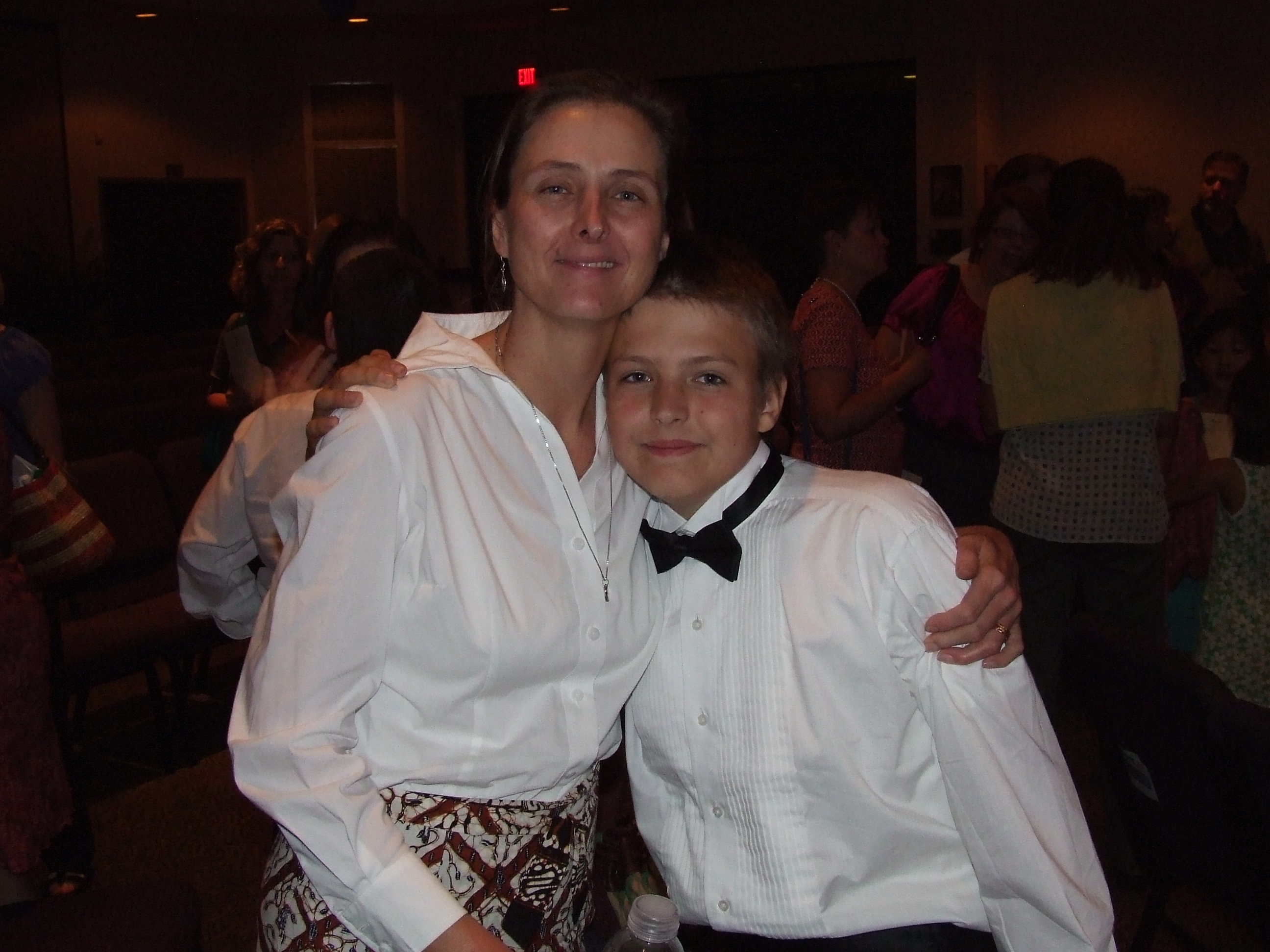
Timberley and Sam at the Trinity Spring Concert

Samuel finished his year at Trinity with a bang.  He performed a beautiful solo with the school choir in the song “Shenandoah.”  Later in the same concert, he sang a duet with a good friend, “Here Comes the Sun.”  He also played baseball this past spring.  It was his first opportunity playing organized ball, as was true for many of his teammates.  Trinity Academy was fielding their first team ever.  There was a pretty steep learning curve as they went up against stiff competition right out of the gate.  After early blow outs, things settled down and the team actually wound up with a winning record.  On May 7, the last game of the season, Samuel collected his first hit and made his first put out in the outfield.  He finished well.

At the awards ceremony, Sam was honored with a national Latin honors award for achieving one of the highest scores on a national standardized Latin exam.  He received the middle school choir member award.  He was recognized for being accepted into the Duke TIP program, an academic talent search that covers the southeast states.  The final award of the evening was an award the school presents to the student who most demonstrates Christ-likeness in their work and attitudes.  Samuel won that award for the seventh grade.  We are very proud of him.

Sam at Awards Night with VA Grandma and CA Papa. His awards are in the background.

Earlier this summer I made a trip with a colleague of mine from the seminary and eight of our students to Malaysia.  We spent two weeks there working with international students in Kuala Lumpur and then working with a variety of people in the northern city of Penang.  It was a very good week.  We saw people come to the Lord.  We shared the gospel and answered questions for international Muslim students.  We witnessed an evangelistic meeting in an aboriginal village, in which the whole village came to follow Christ as Savior.  It was a very exciting two weeks.

When I returned home it was Timberley and Samuel’s turn to go.  They went with a youth group from our church to New Jersey where they helped with a World Changers project.  They worked in small groups doing home renovations for needy people in Neptune, NJ.  During the week, in addition to doing a lot of hard word, Timberley’s team was able to witness to their home owner, who accepted Christ.  His wife has not yet made a decision to believe, but she has started attending church with her husband and is much more open than when the team first arrived.

All in all, it has been a productive summer.  It has been a good summer in many ways.  We are just looking forward to it cooling down now!