May 7 is always a solemn day for us as we are reminded of the loss of Anna. The whole season is complicated, of course, by the nearness of Easter, the beginning of spring, the anniversary of the loss of my mother (May 2), and then Mother’s Day, which is always the next Sunday after the 7th.
In the past, Timberley and I have arranged to be away from home on Mother’s Day and have skipped out on the festivities at church. This year is different. We are at a new church, Faith Baptist Church in Youngsville, NC. We have new responsibilities there. We have other travel planned not too long after Mother’s Day. But for whatever reason, we will be in church this coming Sunday. I think it will be the first Mother’s Day in a long while.
A common theme that I have written on over the years is the bringing together of suffering and hope. I was reminded of this last night when I met with a group of men from our church. We were sharing stories about knowing God’s will in the midst of difficult decisions at various points in our lives. One of the young men–he’s maybe not so young, but he is younger than I–shared about a time in his life, a three or four year period, where he and his wife really questioned whether they had made the right decision about something. They feared that they had moved far out of God’s plan for them. But through that difficult time, an opportunity emerged that would not have been there had they remained where they were earlier. It was clear to them that this new opportunity was the moving of God in their lives. In the midst of difficulties or suffering, our view of God’s work can be obscured, but it is there nonetheless.
With our loss of Anna, that bringing together of suffering and hope is so much more real, so much more vital. There is a tangible loss, a gap in our lives. Yet the hope in the resurrection is so much more tangible as a result.
We continue to miss Anna each day. On this day more so than others. Yet I suppose that we continue to have hope in the resurrection every day. And on this day, more so than others.
We often speculate about what is happening with Anna now that she is with the Lord. Often times, it concerns Anna meeting someone new in heaven. She died almost exactly one year to the day before my mother passed, so we thought much at that time about their reunion together with the Lord.
A few days ago I read the news that Beverly Cleary died. She was 104 years old. If you don’t know who Beverly Cleary is, it is because you don’t have children. Every parent knows the creator of Henry Huggins and the two sisters, Beezus and Ramona. Cleary was a librarian who was disappointed with the state of juvenile literature and so began writing books of her own, that have become award-winning classic literature in that genre.
Anna loved her books. These were among those early “chapter books” that Anna read. And boy did she read. I often tell the story of her bedtime ritual. She read so long at night when she went to bed that we had to make a lights-out time. Also, since she didn’t know exactly what she wanted to read, she would bring stacks of books to bed with her. So we instituted the “five-book” rule. She had to pick five books to read that night and could only read those.
So she would choose, for instance, five of the Ramona books and climb into bed. And this is where it gets fascinating. Anna did not simply pick up one book and start reading. That would be far too simple. No, she would choose one book and read the first chapter of it. Then she would set it aside and go on to the next and read the first chapter of it. And then on to the next book, until she had finished the first chapter of each book. Then she would go to the first book and read chapter two, and so on through all five books. So she would finish five books at night reading all of them at the same time.
She was a fast reader.
We were on an airplane once. I was sitting in an aisle seat next to an older woman, while Timberley and the kids had three seats in the middle section next to me. I noticed the woman opened her bag and took out a children’s book and began reading. I thought that was odd, so I asked her about her books. She was a reading teacher in Chicago and she enjoyed reading juvenile literature. I told her that my two children really enjoyed reading, and she offered one of her books for Anna to read on the plane. I handed it to Timberley and on down the line until it reached Anna. She was quite excited to see a new book.
About 30 minutes later, I don’t remember exactly, Timberley tapped me on the arm, handed me the book back and said that Anna wants to know if there is another. I relayed the message to my new friend. She said, “Oh, didn’t she like this one?”
“I think so, but she’s done and wants to read another book,” I explained.
“What do you mean? She didn’t finish the whole book. Did she read the first chapter?”
“Let me check.” I turned to get Anna’s attention. “Anna, did you finish the book?”
“Yes,” she answered. “I liked it. Is there another?”
I turned back to the woman next to me. She just had a blank stare. “She finished the whole book? But it’s only been 30 minutes (or whatever the time was).” She paused and then looked at me very seriously. “This is very unusual.”
*****
I imagine that meeting Beverly Cleary might be a little like meeting this woman on the plane. She would have four or five books in her bag, just in case she had some time. And she would be fascinated and thrilled by this little girl that would speed read through five of her books at once.
I also imagine that Anna would invite her to join the table for tea. She would introduce her to my mother. She might find a funny hat and a scarf in case Ms. Cleary didn’t have her own. Then she would clap her hands together and call out in her feigned British accent for Maid Nesty to bring them tea.
“Oh dear. Where is Maid Nesty?” But Timberley is not there yet. She will have to get her own tea in the meantime.
Anna, I hope your birthday is a good one and that in this eternity with the Lord, you will also have an eternity talking to others and enjoying one another. I hope you enjoy getting to know Ms. Cleary.
On Sunday morning, as many others were doing around the country, our Sunday School was having a Zoom conference. The members gathered in front of their computers and we each stared at the Hollywood Squares version of our classroom. We have had a good time meeting this way, but we do miss the physical presence we have been avoiding during this period of the Coronavirus.
We have been reading through Romans together and this past Sunday we were in Romans 6. In trying to express the importance of the passage beginning here and extending through chapter 8, I mentioned that when I was in college I was encouraged to memorize Romans 6-8. It was the first large block of text that I had committed to memory and it began a process that then led to the book of Philippians and then James.
Later in the week, Timberley told me she was encouraged by my testimony of scripture memory and decided to revisit her own scripture memorization. She decided to work on Romans 5-8.
She ran into a snag, however, when she read 5:3 in the 1984 NIV: “Not only so [that is, not only do we rejoice in the hope of the glory of God], but we also rejoice in our sufferings, because we know that suffering produces perseverance.” That was fine. Until she read the revised NIV from a few years ago in which it says, “but we also boast in our sufferings.” She asked me which was correct. This question led to a good study on the Greek word translated both as “rejoicing” and as “boasting.” Is this a positive or a negative term? Is this “boasting” a kind of prideful exhibition?
As it turns out, the term is rather neutral, and it has to pick up the positive or negative meaning from the larger context. In the context of Romans 5:3 it is clearly intended to be positive. Which leads to the next question. What does it mean to “rejoice” or to “boast” in our sufferings? What sufferings are these?
Today is the 12th year since Anna died. It is usually a quiet day for us. It is a sad day. It is a reflective day. Since the Sunday following May 7th is always, I believe, Mother’s Day. That weekend is one in which Timberley and I, and Sam when he was still with us, would go away for the weekend and take a retreat from the Mother’s Day celebrations and flower-giving in our church.
One year we went to the Outer Banks. It was a beautiful weekend. Another year we went camping at Mount Mitchell. It was an interesting weekend. But we always spend time away. What to do this year?
The Coronavirus this year took away the need to escape the gaiety of church life since none of us are meeting anyway. But Timberley took care of that decision with certainty yesterday. We are in the process of cleaning and painting our garage. Yesterday morning I went to a neighbor’s house to help her with a small task there. When I returned home I found Timberley sitting in a chair in obvious pain, with a towel wrapped around her foot and leg.
“I sprained my ankle going out to the garage,” she said, holding back tears. For Timberley, of course, the tears are mere emotion grabbers. This is a woman that gave birth twice with no pain medicine. An 8 out of 10 on a pain scale for a normal person makes her twitch. So her tears were there to let me know that this was serious.
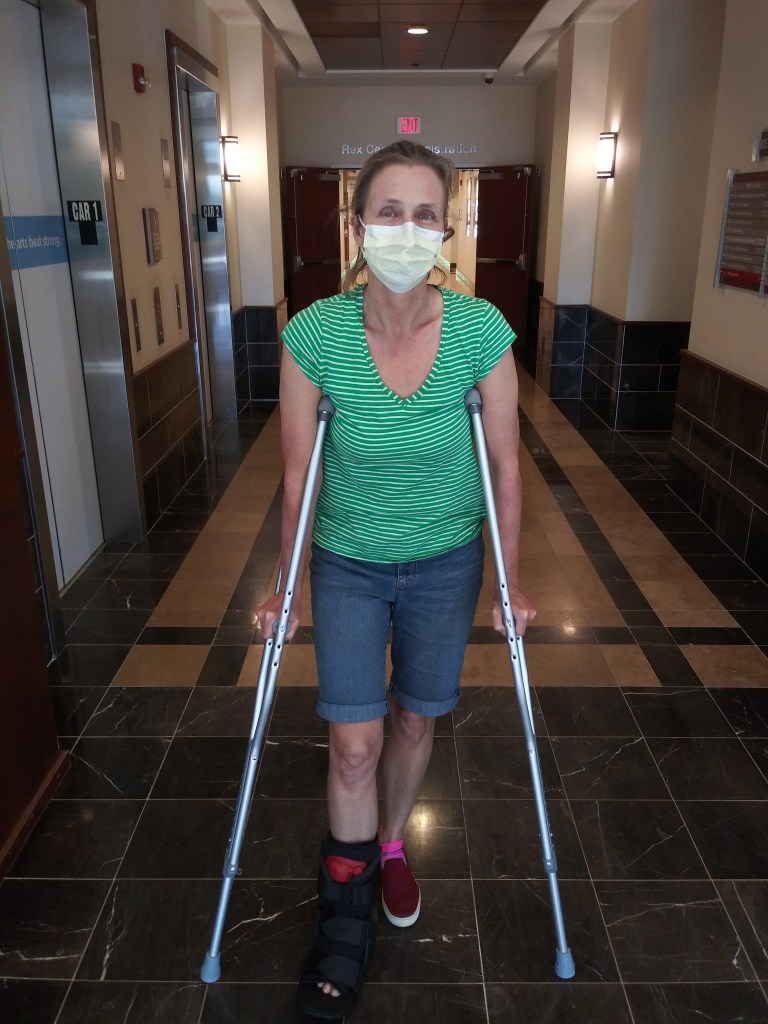
To make a long story short, she was wrong. She did not sprain her ankle. She broke her foot. She will now be spending the next six weeks in a boot with crutches.
So our May 7th this year was spent visiting doctors and getting x-rays. It certainly kept our attention busy for the day.
Timberley asked me last night, or this morning, if the suffering in her leg was related to the suffering of Romans 5:3? “Of course it is,” I answered. But how? The suffering of her leg, along with the suffering of the virus sickness, the suffering of the economic depression we are in, the suffering people’s mental stability during the quarantine period, the suffering of fractured relationships due to physical separation, the suffering of fractured relationships because of rising political and other tensions, the suffering of a little girl falling from a cliff 12 years ago, the suffering of a grieving mother and father and big brother in the ensuing years, all of this suffering “counts,” as Timberley likes to say. (“But who’s ‘counting’?” I always reply.)
All of this suffering, according to Paul develops perseverance. He goes on to say that perseverance develops character, and character develops hope. And hope–the muscular kind of biblical hope–does not disappoint. Christians are sure of the things to come. We do not walk around wondering. We do not merely guess at things. We have hope. Real hope. And according to Paul, that kind of hope begins when we rejoice in our sufferings, knowing that we are participating in some small or large way in a broken world that Christ came to fix. We are experiencing in some small or large way the sufferings of Christ as he died in our place. We are experiencing in some small or large way the sufferings common to all mankind that bind us together before our God.
So on this May 7th, do not begrudge the difficulties you are experiencing. Do not think that God has cast you aside. Do not think that God does not care about your sufferings. He cares. He loves you so much that he sent his son to suffer and die in your place in order to pave a way out of this world of suffering and into a glorious inheritance that will never fade away, and in which there will be no more tears of sorrow.
Timberley and I bought our first digital camera shortly before we moved to Indonesia in 2003. Anna was nearing her 4th birthday. Sam had just turned 6. For those of you who have crossed the great divide from the analog to digital world, you know that in reminiscing, it is very easy to think that life began with digital pictures.
One year old Anna with what would become her favorite pastime–books.
But of course, there was an analog life before everything became cloud-based. Yesterday Timberley opened one of the boxes that has traveled around the world with us several times, but has seldom if ever been opened. In it, we found envelopes and albums full of photographs. We spent the next several hours looking at our life before Indonesia. We had baby pictures of Sam, baby pictures of Anna, a wonderful album given to us by the good people at San Bruno Chinese Church, another album filled with Timberley’s memories of her time in the Middle East. We had a great afternoon full of laughter.
Anna staring at her favorite big brother, Sam.
Today is Anna’s 21st birthday. Timberley and I were thinking this morning about a 21 year old Anna. She would be close to finishing her dual college degrees of marine biology and art, so she could draw pictures of fish. She would likely be engaged to a young man with a certain name since she seemed to have a soft spot for boys with that name. (I’m keeping the name private in case one of those young men is reading this now.)
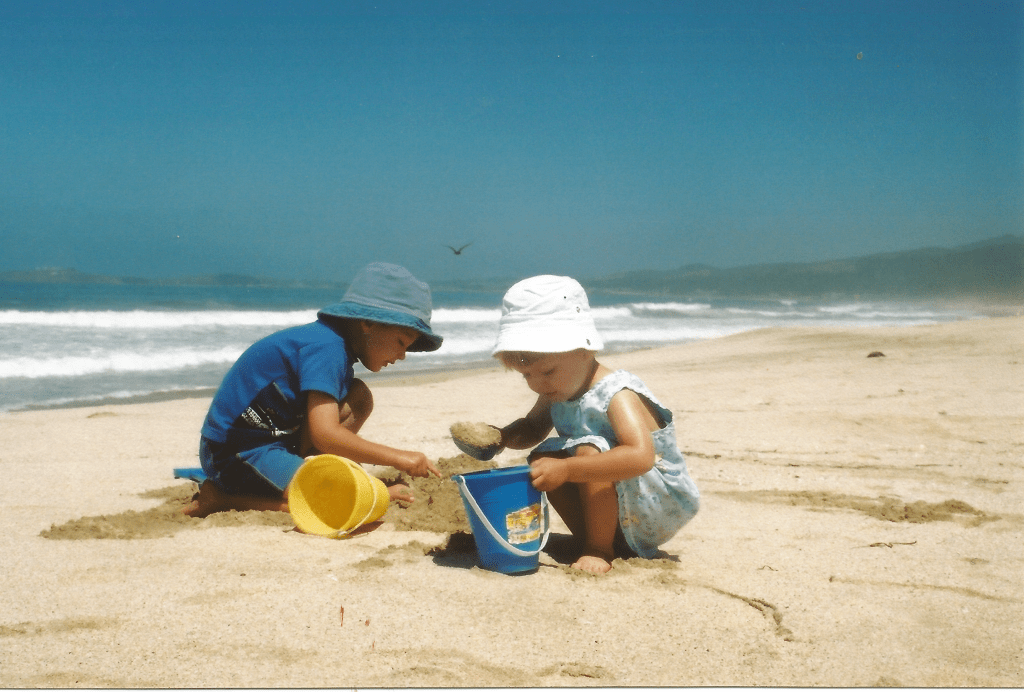
Sam and Anna on a California beach.
But in the end, whatever good thing we could think of for Anna’s hypothetical future paled in comparison to what God had planned for her. She could have been drawing pictures of fish, but now she is enjoying the creator of the fish. She could have been engaged to some young man, but now she is preparing for a far greater wedding feast. In fact, all of our best plans for Anna do not compare to the unsurpassed goodness of God’s riches stored up for her.
Anna at Ridgecrest during our appointment ceremony.
And so it is for us. During times like these, with the Coronavirus taking its toll around the world, we can begin reflecting on things that are important to us. We can consider the importance of family, our home life, the other relationships that are important to us. And it is right that we should be thinking of such things. But the best life that we can imagine is really just a pale shadow of the incomparable riches God has stored up for those who believe and trust in his son, Jesus. May we all do our best during this time to remember those things that will most give our lives meaning while we are here. And then may we realize the greater good that we cannot imagine that is waiting for us.
Happy 21st birthday, Anna! You are still missed and loved.
This anniversary of Anna’s death has been stranger than others. It is reminiscent of our time ten years ago, when my mother passed away on May 2, almost exactly one year after Anna.
This year, we received word Sunday morning that the son of a dear friend of ours had been killed in an accident the day before. We gathered with friends from our church and our friends’ neighbors and sat with the grieving couple. We listened to stories. We cried with them. We sat quietly for long times. We laughed hysterically at times.
For Timberley and me the afternoon was a bit surreal. Our own memories of a house full of friends and neighbors 11 years ago filled our thoughts. Memories that are so, so bittersweet. The bitterness is still tangible–the steely taste that overpowers all other tastes. Yet the sweetness of the kindness of our friends is just as palpable today as it was those years ago.
When we entered our friends’ home early Sunday morning, we embraced and sobbed long, heaving cries together. They cried because they had lost their only son. We cried because we understood. Then my friend looked at me and said, “I never knew before what you had been through. I am so very, very sorry that you went through this.” I tried to deflect his attention to our grief. But I understood all too well what he was feeling.
After Anna died and following the memorial service we held in California, I left the sanctuary of the church and was met by a solemn man standing with hands in his pockets. Sunglasses hid his tears. This was a friend I had known since childhood. Years earlier I had given his son drum lessons. That son was killed tragically in a home accident. I have always remembered, in the aftermath of that accident, sitting with my friend and hearing him say, “It seems like every one has abandoned us. No one will talk to us about our son. No one brings him up anymore and they stay away from us now.” When he told me that, I remember thinking to myself, “We just don’t understand. Everyone is afraid.” So, years later, when I was leaving the sanctuary and saw my friend in deep anguish, I gave him a hug and we cried together. I understood now and I knew that he understood. If I had been wise enough I would have said what my new friend said to me, “Now I know what you went through. I am so sorry.”
It is important to feel sympathy at the right time. We need to be able to recognize that another is experiencing grief and to act accordingly. Empathy is a deeper feeling in which we not only recognize the emotion in the other, but we take part in it ourselves. Empathy, I imagine, that wells up out of the same spring that feeds the sorrow in the other is the strongest form of empathy. That is when the tears and sobs, but also the laughter, become the strongest.
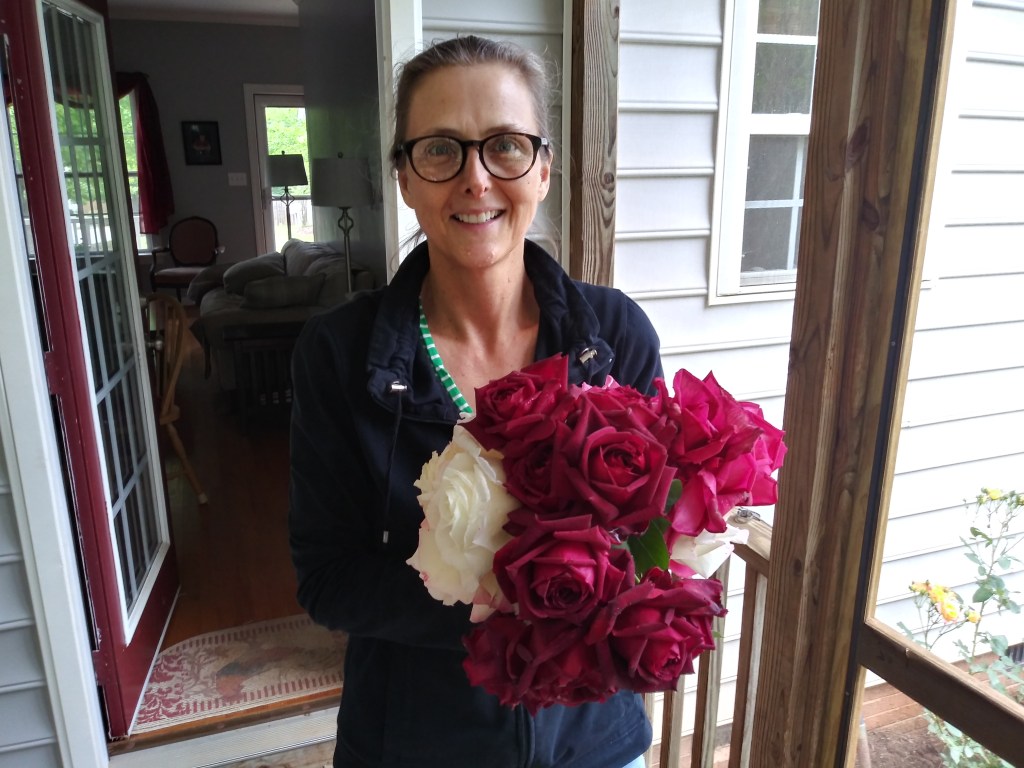
Today is Anna’s birthday. She would be 20 today! A friend brought flowers to Timberley this morning. She apologized because the blossoms were all small. I carried them to the kitchen to put them in a vase. Timberley said what I was thinking. “The flowers are small, but they remind me of Anna.” I assume this is universal, but with the passing of years, the person we lost has been frozen in time. Anna will always be nine. She is unimaginable as a 20 year old college student.
Today is also a very beautiful early spring day here in Wake Forest. We have had several false starts to spring, but I think this one is for real. The sun is shining. I can hear birds outside. We started a new enterprise in our backyard. We are raising chickens for eggs. When I went to see them this morning, their plumage is getting beautiful. The cherry trees all over town are blossoming. The dogwoods will come soon.
I had lunch with a friend on Wednesday and he asked me how Anna’s death had changed me. I didn’t know how to answer that. Maybe because so much has happened since that time. There have been so many changes in our lives. But one very real, very tangible change in me is that spring time has so much more meaning now. This is the time when the dormancy and death of winter gives way to the awakening and new life of spring. Springtime is the annual notice that the hope we maintained all winter was not in vain.
The psalmist in Psalm 19 tells us that God’s creation tells of his wonders. I see in the transition of winter to spring the gospel of Jesus Christ. The death that comes as a result of sin gives way to the new life that comes by grace through faith in Jesus Christ. Nature is proclaiming the gospel of God.
May this spring time be to each of you a reminder, or maybe the first news for some of you, that God’s plan is for salvation and life. And the patience we have now as we await the resurrection is not in vain, but just as spring follows winter, we must believe in the resurrection.
Timberley and I just had lunch with a friend of ours who drove up from London to meet us at the Tyndale House. We met Lindsay when she and her husband came to Indonesia to begin their work there with our same organization. They moved to our city because to do their language study. After several years in Indonesia, they moved to London to continue their work there.
Lindsay was there when Anna died, and was one of the ladies who helped Timberley while Anna was missing before we found out what had happened with the bicycle accident. She was very much part of what took place during those very difficult few days.
But as it turns out, Indonesia was not our first interaction with Lindsay. I did not know this, but Lindsay was in a class at Southern seminary in Louisville in 2006 when our family was on a stateside assignment. During a missions emphasis at the seminary I was invited to speak in a church history class. Lindsay was in that class. I don’t remember now much of what I said, but I do remember that at the end of my presentation there seemed to be an inordinate number of questions about the struggles of family life on the field. They wanted to know how my wife was doing. How were my children adjusting to life on the field.
Lindsay reminded me of that day as we had lunch today. She told me that I shared a particular story about Anna that she has never forgotten because that story helped with her decision to go to the mission field.
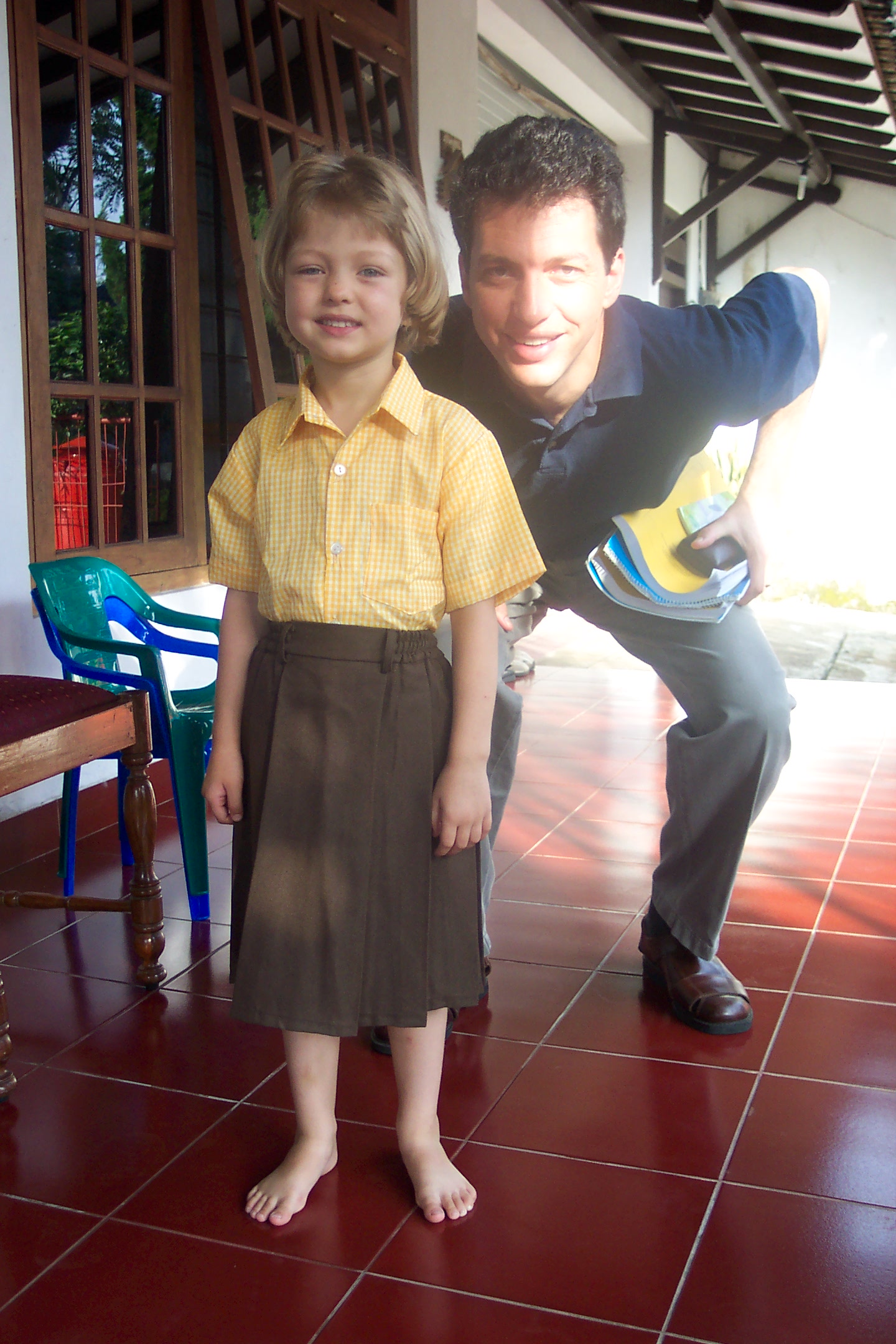
When Anna was five or six years old, we were preparing to move from Salatiga to Semarang. She had finished a year of Indonesian pre-school. I asked her on her last day of school if she was going to miss school.
“No,” she said.
“Well what about your friends there. You’ll miss them, won’t you?”
“No, I don’t really have any friends at school.”
“But at play time, don’t you have fun with the other kids in the play yard?”
“No. I just go to the swing, because I can be alone there and I don’t have to talk to anyone.”
Keep in mind that at this time, Anna knew no Indonesian and was quite shy about learning any, so her attitude was not unexpected. Still, I kept grasping for some positive aspect to her year at school. “Well what about your teacher? You’ll miss her.”
As I recall, this last question made Anna laugh out loud at the suggestion. “No. She’s really mean. She always yells at the children.” I always thought that her teacher reminded me of a female, Indonesian, Sgt. Carter, so I guess I should have know better.
Finally, in desperation, I asked, “Well Anna, is there anything at all that was good about your year in school?”
“No. Not really. I won’t miss it at all.”
“But Anna, I thought you liked going to school every day.” She made a funny face and shook her head no. “Why didn’t you say something to us?”
“Because I knew that that’s what I needed to do.” Anna knew that her Mom and Dad were in language school and that God had called us there. Sam was old enough to go to the international school for first grade. She was doing her part at the Indonesian school. That was her bit of sacrifice.
So that was the story I told in class that day back in 2006. What I didn’t know was that a young Lindsay was in the class struggling with understanding how God might be calling her and her husband to the mission field. One of the big questions she had was concerning children. How could she take children to the mission field. When she heard Anna’s story about sacrificing even at five years old, she knew that God would take care of them, too.
About two years later, Lindsay and her husband arrived in our city and there we were. And there was this little girl that was so instrumental in bringing this new family to the field. She so wanted to meet Anna. When she did, she found this vibrant, young girl who was excited about the Lord.
But then, just as quickly, Anna was gone from our lives.
At lunch today, Lindsay told us this story of how Anna helped to clarify God’s call on her life. She told us as well that she tells all of the teams from America about how Anna affected her life and about Anna’s vibrant faith in Jesus.
It was encouraging for Timberley and me to hear this story. We never know all of the various ways that God is using us and the events in our lives in so many ways that we are not even aware of. The tragedies in our lives are part of a much larger picture of what God is doing. The fact that God is using these tragedies does not make them any less difficult or somehow cause us to view these events as good things in and of themselves. But it does help when we step back a bit to see the larger picture of God’s work in our lives and in the lives of those around us, and even in the lives of people that we do not know. Anna had that impact on Lindsay, and today, in some small way, I think Lindsay had that impact on Timberley and me. To hear about the ministry Lindsay and her family is involved in and to know that God had used Anna, in her seemingly small way, to bring all of this about . . . how would I say it? It doesn’t make it worth it. But it does help give meaning to these things.
Timberley and I are in England as I am writing today’s post. We are staying for one month at the Tyndale House in Cambridge, where I am reading and writing for a few projects. Our change of place and routine brought on a few unintended changes for me. Yesterday (May 6), Timberley asked me something about today (May 7). My slow response must have alerted her that I did not know the day’s date. “You do know what tomorrow is, don’t you?” Just then, I remembered the date. Yes, today is the sixth. Tomorrow is the seventh, I thought. How could I have forgotten? It is that day.
But then, I began working through the events and adventures of our day. There were reminders of Anna everywhere. Well, some were reminders of Anna. Others were those events that are new to us for which we can only wonder about Anna’s response. The first were things like being in a church service at Eden Baptist Church with what seemed a hundred families with young girls, from babies to young teens. Was there even a boy in the congregation? I didn’t see one. Or, perhaps more darkly, walking on a street and being passed by a young girl on a bike, being followed by her mother who was carefully calling out cautions to the young girl about not riding into the street without looking, which seemed to go unnoticed by the girl. We walked on silently, as I prayed silently that nothing would go wrong in front of us.
The second type of event was on our afternoon bus ride to nearby St. Ives and the beautiful walk along the Ouse River to Houghton. Along the way we saw a pack (is it called a pack? Or a herd? Or some other name?) of llamas or alpacas, freshly shorn and enjoying the recent sunshine that seemed to have arrived in Cambridgeshire at the same time we did. In moments like those, we know of course what nine-year old Anna would have thought of those funny creatures. But we have to enjoy those new things without her.
We have had a delightful time so far in England and look forward to many more good experiences and adventures. My brother Richard and his wife, Dianna, flew with us from America to London and we stayed for a few days with them there. On our first day we visited the Churchill War Rooms. The second day we traveled to Windsor to see the Castle. Among our other adventures that day, Timberley saw a family touring the castle, and she went and listened in on their conversation to discover that they were Indonesian. They were traveling from Medan and had visited the United States and the United Kingdom. We had a nice conversation. They were very excited that we were able to speak Indonesian with them. Timberley remembered her language very well. As would be expected everyone exchanged hugs and handshakes. Hugs for the women. Handshakes for the men. And photos. There are always photos to be taken.
We stayed after the castle closed to attend an Evensong worship service in St. George’s Chapel, where the upcoming royal wedding will be held. Earlier in London, we attended an Evensong service at Westminster Abbey. I decided then that when it was in my power to do so, I would visit old churches during times of worship rather than simply during the tourist hours. Doing so, we could experience the church building in the context in which it was designed–not as a museum piece but as a part of a living and worshiping community.
After our walk to Houghton yesterday, we experienced a bit of the living community of the church in St. Ives. We came back into town, hot and tired from our walks, looking for a place to have afternoon tea. We happened to see in the churchyard a sign advertising tea at the church. A few folding tables were set up in the grass in front of the church where a half dozen people were enjoying tea and conversation. We decided to join them for their tea time. We met some quite friendly people who helped us through the ritual of tea and scones. It was our first “proper” tea. (The British seem to take pride in being the only people who know how to do something the “proper” way. In Cambridge there is a restaurant advertising a “proper” hamburger. Another advertised “proper” pasta. Perhaps some Italians will venture here to find out the right way to make their own food!) While we were there we picked up a printed announcement about next month’s event, which we will unfortunately miss. “Booze in the Pews” is a three-day event to be held in the church with “12 Real Ales” and other beers and ciders. I don’t know what a “real” ale is, but I suppose it is something like a “proper” ale. The things we miss in America.
While today marks ten years since Anna died, it is also the most unusual day of remembrance for us as we are in a place where nothing is normal and everything is new. The newness of things ought to be a reminder to us of the newness of heaven.
I am writing this in the library at the Tyndale House. A gong recently sounded which marks the first of two tea times. I retreated with the others to the Common Room where we have tea or coffee and socialize. There I engaged with a man I was just meeting for the first time. In the course of our conversation, we had an opportunity to speak of the three NT aspects of salvation–what we term justification, sanctification, and glorification. I made the observation that it could be helpful to pray for others through all three stages of this process: for the lost that they would come to know Christ, for those who believe that they would increase in holiness, and for those whose life here has ended that God would complete that act of salvation in heaven. My new friend commented on the third prayer, “It seems to me, though, that that is already decided. Isn’t it a bit of a wasted prayer?”
I don’t believe so. When I pray that God would save Anna, I am not praying that she would be justified. That happened long ago at our house in Salatiga. I am not praying that she would sanctified. We saw that happening daily in her final five or so years. What I am praying for is that God would complete that work of salvation by giving to Anna “that inheritance that will never perish, spoil, or fade–kept in heaven” for her. Is there some uncertainty over whether God will do that? Not a bit. I am completely certain that God will accomplish these things according to his word. Does that mean we do not pray for it? I hope not. Our prayer should always be based on the promises God made to us in his word.
And so we pray now. Come, Lord Jesus. Bring all things to their proper and fitting conclusion. As you have saved us in the past by bringing us to the point of faith, continue to save us through the sanctifying work of your Holy Spirit, and save those believers who have gone before us by bringing them into their unperishable inheritance. Amen.
We are entering into that time of year again with the remembering of Anna’s birthday, Easter approaching, and then the day remembering her death. I have written a number of times here about the confluence of these days and the perhaps backwards ordering of the events–it would have been very nice if Easter came last in the sequence, but we have what we have.
Anna would be 19 today. My goodness, how difficult that is to think about, but as Timberley reminds me, Anna will always be nine years old.
I had a moment of confusion the other day. The kind of moment I have had before, but not often. It was not about Anna, but rather my mother, who passed away one year after Anna. I was thinking about some good friends of ours here in Wake Forest and I began remembering the times that they had spent with my mom when she and my dad visited here. I had very vivid memories about how much my friends loved my mom and our laughter together. And how they missed my mother.
And then I remembered. My mom never came to Wake Forest. She passed away three days before I received my first communication about the job I have here. She didn’t know anything about my position at the seminary, or Wake Forest, or anything else related to our current situation. And yet from time to time I have these memories of my mom’s presence here with us. It is interesting how our memories work over time.
There was a milestone that came and went without my realizing it. It happened some time last June. Around June 15th or so, if my calculations are correct. We passed the time when we have spent more time without Anna than we had with Anna. That is hard to imagine because in so many ways time tends to stand still now. Yet, I think what happens, as with these memories of my mother, is that in our memories we bring those people along with us into the remainder of our lives. Their absence, in a way, is only partial. They are physically absent, yes, but our memories of them create a real presence in our lives. Since we are living on with those presences of Anna, of my mother, and of Timberley’s sister and the several others we have lost in recent years, the time without them doesn’t seem so long as the calendar would indicate.
It is interesting that this year Anna’s birthday coincides with Maundy Thursday, when the church remembers the evening that Jesus spent with his disciples prior to his arrest and crucifixion the following day. On that night he took bread and wine and shared it with his disciples saying, “Here is my body.” And then, “Do this in remembrance of me.” Various factions within the church have interpreted those aspects of the Lord’s Supper in various ways: transubstantiation, real presence, symbolic memory, etc. But perhaps these views are not so far apart as the history of the church would say. Perhaps, as I am finding with Anna and with my mother, the memory is a type of real presence. And is this real presence so different from the physical presence of the person herself?
I shared some of these thoughts with Timberley this morning. We both shared the pangs of missing Anna. I told Timberley that I better understood the meaning and importance of the clichéd charge to “keep their memory alive.” I suppose that for some, keeping the memory of a lost loved one is too difficult. It is better to suppress those memories. If that is someone’s path, I do not want to quarrel with them. But it is not my path. The memories do create painful moments. Not always. But often enough. Yet I can’t imagine life without the twin siblings of memories and pains.
Which then brings me back to our remembrance of Jesus’s death. It might seem odd that the church would want not only to remember his death, but to celebrate it. To call tomorrow Good Friday, of all things. Yet in a very real way, our memory of Jesus, which he called us to have when we celebrate the Lord’s Supper, is one aspect of the sustaining of Jesus’s real presence in our lives.
I pray that for each of you, Jesus would have a real presence in your life this year.
On Sunday’s post I mentioned a tune I had recently heard by the jazz pianist Joel Weiskopf. After I wrote that, I found the lyrics for the song and wanted put them here. If a Christian did not write this lyric, then here is surely an example of common grace.
When lonely feelings chill
The meadows of your mind,
Just think if Winter comes,
Can Spring be far behind?
Beneath the deepest snows,
The secret of a rose
Is merely that it knows
You must believe in Spring!
Just as a tree is sure
Its leaves will reappear;
It knows its emptiness
Is just the time of year
The frozen mountain dreams
Of April’s melting streams,
How crystal clear it seems,
You must believe in Spring!
You must believe in love
And trust it’s on its way,
Just as the sleeping rose
Awaits the kiss of May
So in a world of snow,
Of things that come and go,
Where what you think you know,
You can’t be certain of,
You must believe in Spring and love










 Timberley and I are in England as I am writing today’s post. We are staying for one month at the Tyndale House in Cambridge, where I am reading and writing for a few projects. Our change of place and routine brought on a few unintended changes for me. Yesterday (May 6), Timberley asked me something about today (May 7). My slow response must have alerted her that I did not know the day’s date. “You do know what tomorrow is, don’t you?” Just then, I remembered the date. Yes, today is the sixth. Tomorrow is the seventh, I thought. How could I have forgotten? It is that day.
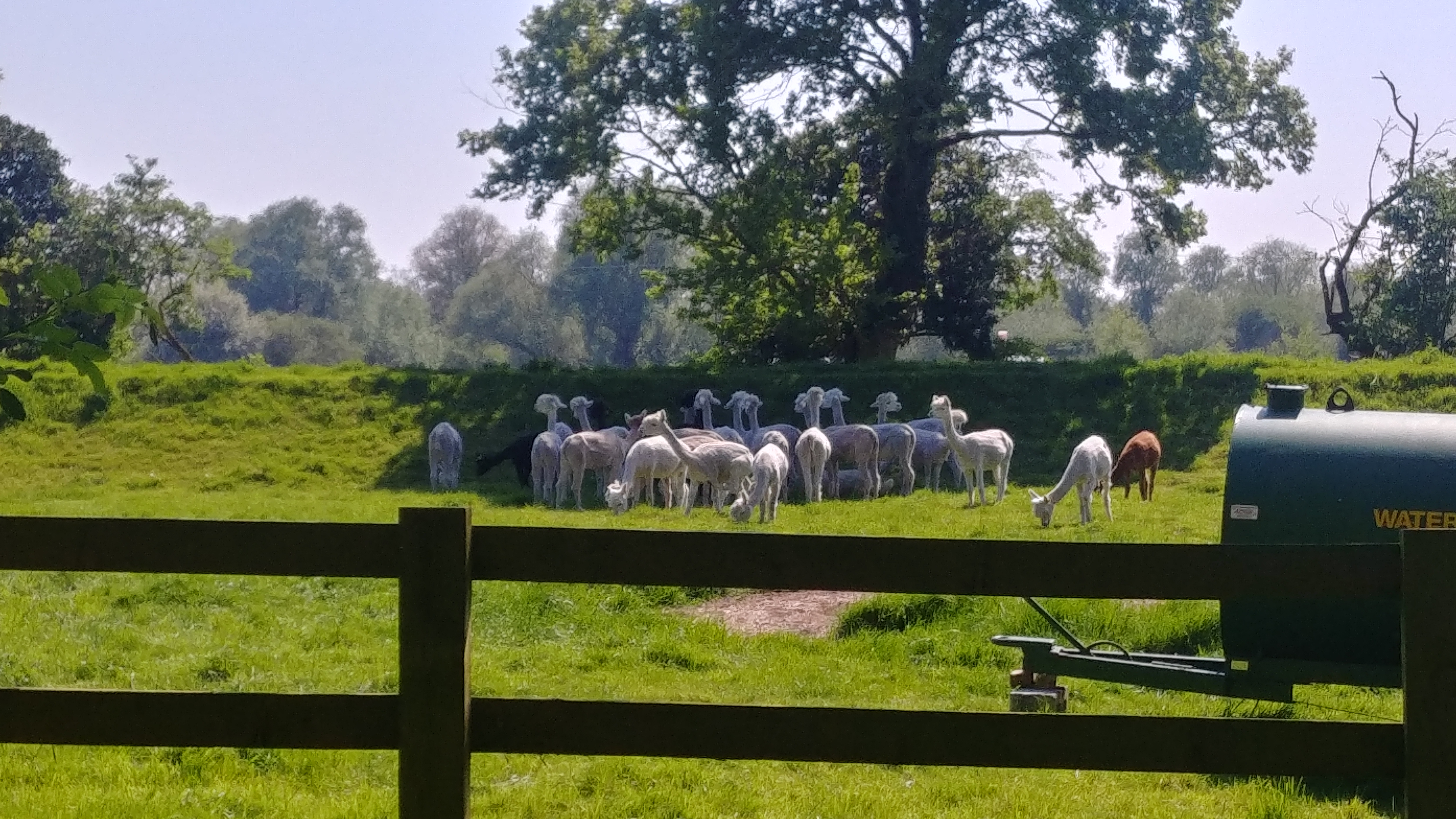 The second type of event was on our afternoon bus ride to nearby St. Ives and the beautiful walk along the Ouse River to Houghton. Along the way we saw a pack (is it called a pack? Or a herd? Or some other name?) of llamas or alpacas, freshly shorn and enjoying the recent sunshine that seemed to have arrived in Cambridgeshire at the same time we did. In moments like those, we know of course what nine-year old Anna would have thought of those funny creatures. But we have to enjoy those new things without her.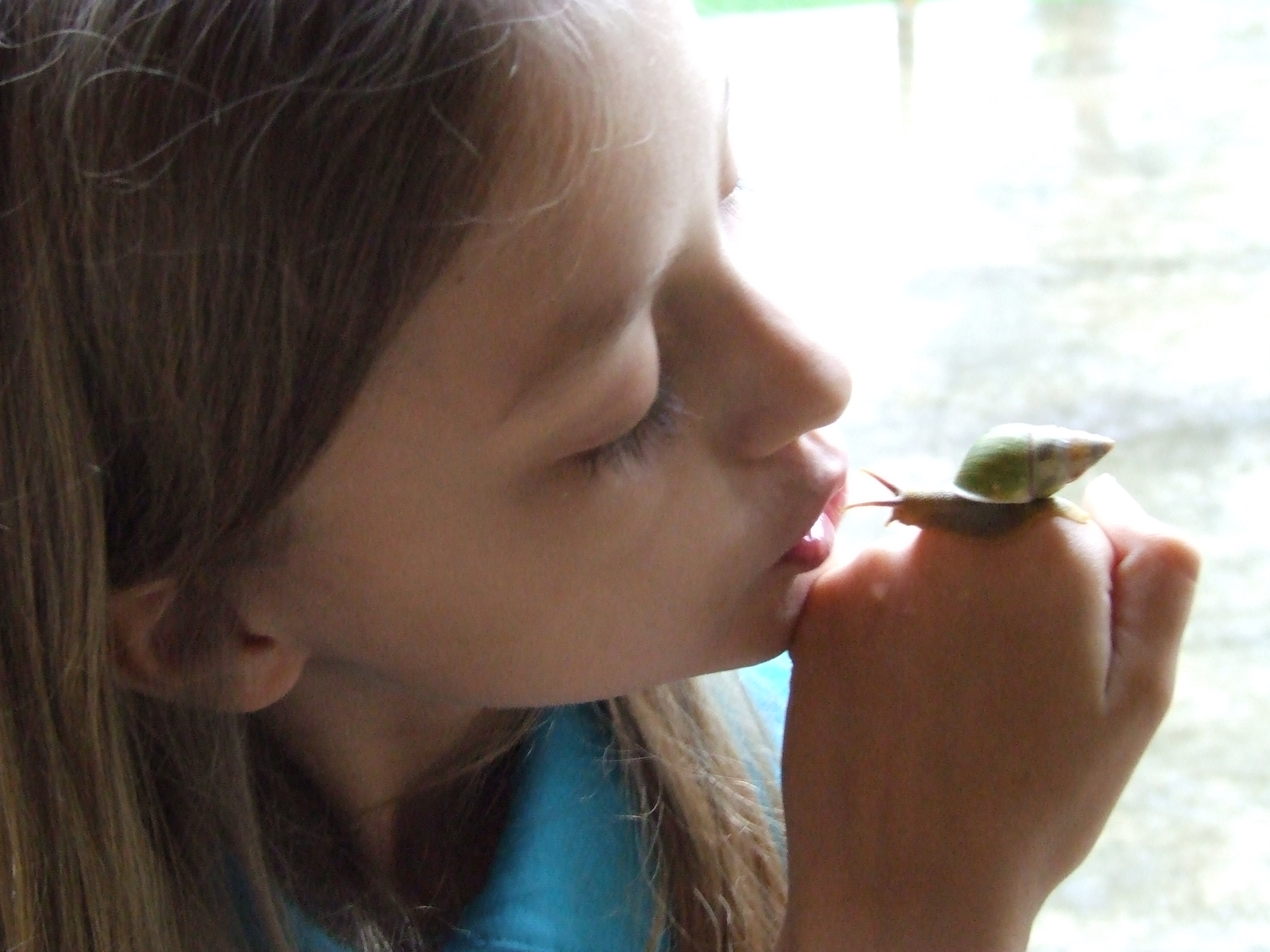


 Anna Resurget